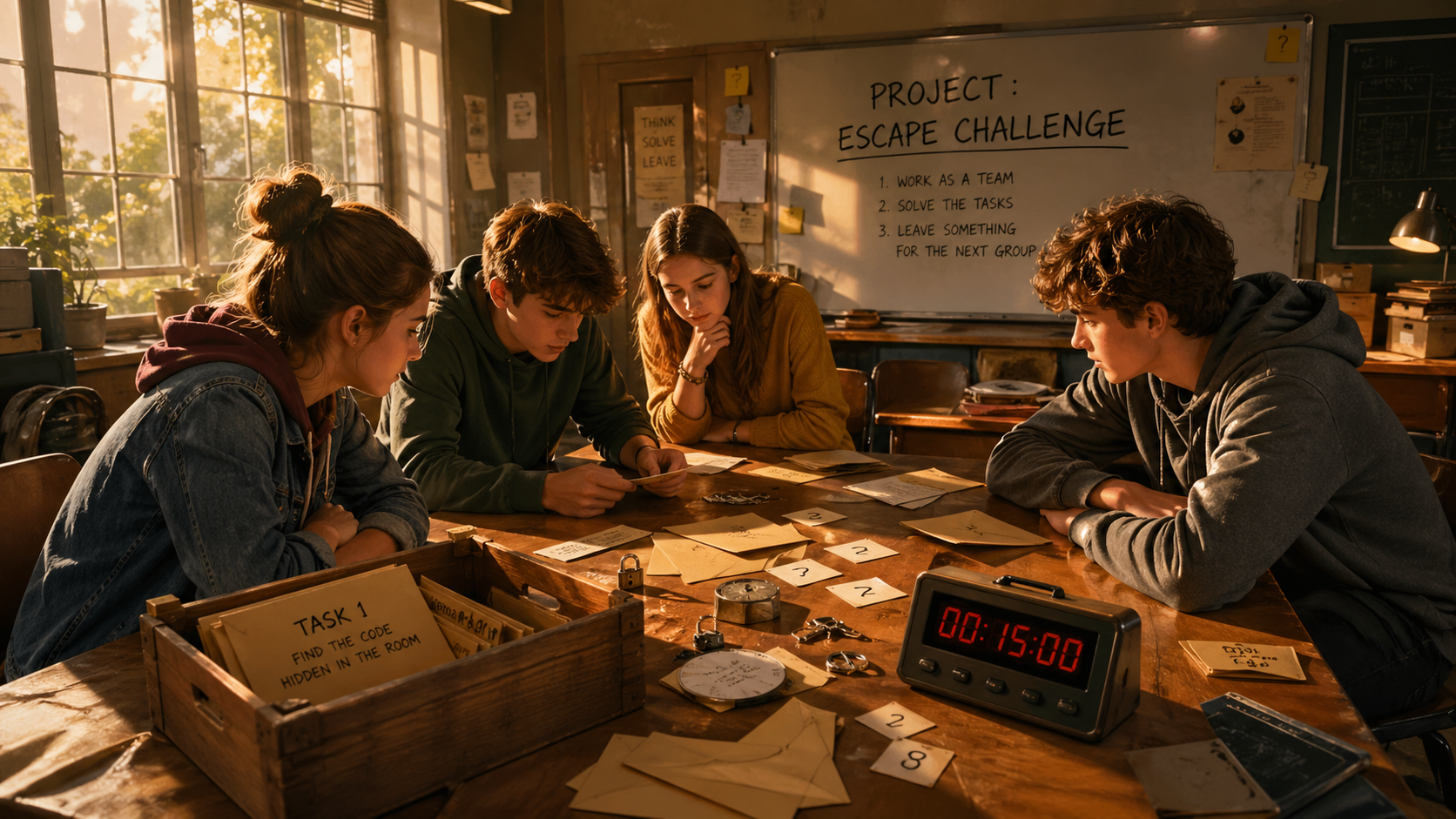
The room was quiet, but it was not empty. In fact, it looked surprisingly organised. There were desks, chairs, a whiteboard, and a neat shelf with boxes. Compared with the dusty corridor outside, Room 3B looked as if someone had prepared it carefully.
Leo looked around and relaxed a little. “Okay,” he said, “this is not what I expected.” Sara agreed. She had imagined something darker and stranger, but the room looked more like a project space than a forgotten classroom.
Adam walked to the whiteboard. At the top, written in clear handwriting, were the words: WELCOME TO ROOM 3B. Underneath, there was another line: PROJECT: ESCAPE CHALLENGE.
Maya read the instructions aloud. The group had to work as a team, solve the tasks, and leave something for the next group. Suddenly, the room felt less mysterious and more exciting. It was not just a hidden room. It was an escape-room project inside the school.
On one of the desks, Maya found a box. Inside, there were envelopes, small keys, pieces of paper with numbers, and a simple digital timer. Sara picked up the first envelope and read the task: Find the code hidden in the room.
At first, Leo acted confident and said it would be easy. But after a few minutes, they realised the clues were not random. Some numbers were hidden under desks, others were written inside old posters, and one clue was attached to the back of a chair. They had to communicate clearly and share what they found.
Adam noticed a pattern in the numbers. Maya connected the pattern to the order of the posters on the wall. Sara checked the envelope again and found a hint they had missed. Finally, Leo entered the code into the lock on the box.
There was a small click. The box opened. Inside, they found a note that said: Good. You are working as a team. Final task: record your message for the next group.
For a moment, everyone smiled. This was not a trap or a prank. It was a secret tradition. Students had created the room, completed the challenge, and left something behind for the next team.
Leo picked up a small camera from the desk. “Then we’re officially part of it now,” he said. They placed the camera on the table and recorded their message. Maya introduced them as Group 3. Adam explained how they had found the room. Sara warned the next group to read the clues carefully. Leo leaned into the frame and added, “And don’t let anyone pretend they solved everything alone.”
They laughed, and Maya stopped the recording. For a moment, everything felt normal again — just four students taking part in a clever hidden project. Then Leo looked down at the digital timer on the desk. It was running. Nobody had touched it.
The numbers counted down silently: 00:10… 00:09… 00:08… Sara frowned. Adam stepped closer. Maya watched the timer reach zero. Nothing happened at first. Then a small light turned on above the door.
They all looked up. Above the frame, new words appeared: LEVEL 2 UNLOCKED. Leo smiled slowly. “Okay,” he said. “Now I’m definitely staying.”